
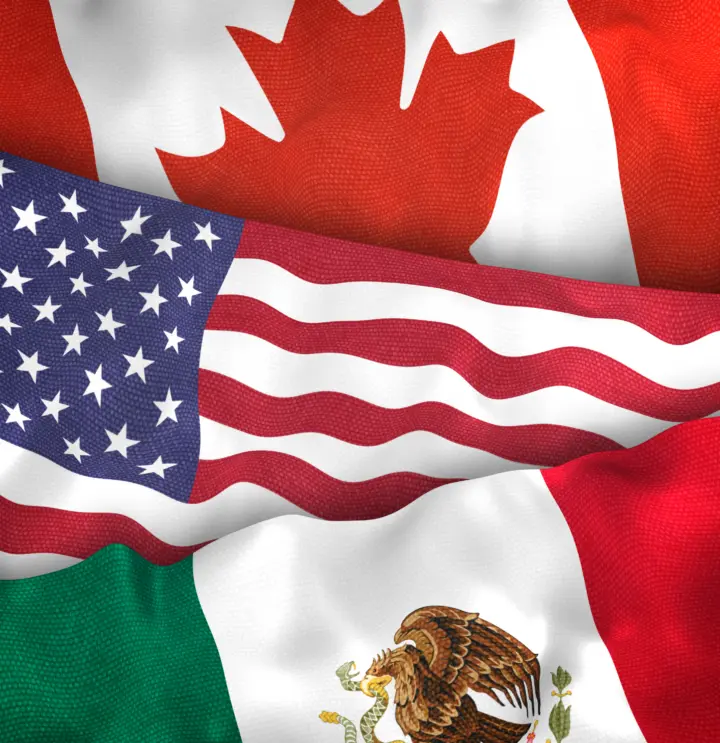
A Vital Framework for North American Competitiveness
The U.S.–Mexico–Canada Agreement (USMCA) underpins a deeply integrated North American cosmetics and personal care market. It supports supply chain efficiency, regulatory cooperation, and long-term investment—benefits that matter as the agreement enters its 2026 Joint Review.
Why USMCA Matters
North American trade in cosmetics and personal care products reached $9.3 billion in total North American personal care products trade in 2025.
This figure represents two-way trade flows between the United States and its North American partners and accounts for nearly 25% of total U.S. global trade in the sector. This growth reflects a highly integrated regional ecosystem—one that depends on predictable, tariff‑free trade and compatible regulation.
Our industry operates across borders:
- Ingredients, components, packaging, and finished products often cross borders multiple times before reaching consumers
- Zero tariffs and workable Rules of Origin allow companies to operate efficiently at scale
- Disruption would increase costs and inject uncertainty into a system that works
USMCA provides the stability manufacturers need to invest, innovate, and grow in North America.
A First-of-a-Kind Cosmetics Annex Delivering Real Results
USMCA includes the only cosmetics-specific annex in any U.S. free trade agreement, setting a global benchmark for regulatory cooperation and producing measurable gains. The Annex:
- Promotes harmonization across key, integrated export markets
- Advances balanced, risk-based regulation
- Eliminates market approval requirements
- Reduces unnecessary animal testing
- Streamlines labeling and notification rules
Together, these commitments remove longstanding regulatory barriers, reduce costs, improve efficiency, and enable smoother cross-border trade, strengthening U.S. competitiveness across North America.
Real-world impact: Canada, the leading export market for U.S. cosmetics, eliminated quarantine and retesting requirements. This removed a major barrier and saves U.S. exporters over $102 million each year.
The 2026 Joint Review: What’s at Stake
Under USMCA’s Joint Review provision, the three governments will decide in 2026 whether to extend the agreement.
If the parties do not agree to extend:
- Annual reviews begin in 2027
- The agreement would expire in 2036 if no extension is reached
While procedural, the 2026 review comes amid heightened trade enforcement, tariff actions, and political scrutiny. Even structured reviews can introduce market uncertainty, particularly for industries reliant on cross‑border supply chains.
What the Industry Needs
For the cosmetics and personal care industry, the objective is clear:
Preserve what works:
- Maintain USMCA as a trilateral agreement
- Protect tariff‑free movement of USMCA‑compliant goods
- Avoid changes that would disrupt a high performing regional platform
Stability and predictability are essential for long-term manufacturing decisions and cross‑border investment.
PCPC’s Position
USMCA delivers measurable value to the cosmetics and personal care industry. As governments approach the 2026 Joint Review, policymakers should focus on continuity, certainty, and competitiveness—and take a “do no harm” approach to an agreement that works.
Public Comments and Statements
Personal Care Products Council Statement on the Value of the USMCA in Strengthening U.S. Competitiveness
Statement from the Personal Care Products Council on Implementation of USMCA, a Significant Milestone for Free Trade
Personal Care Products Council Among Leading Organizations to Join USMCA Coalition
FAQs
Lorem ipsum dolor sit amet, consec tetur adipiscing elite. Suspen disse varius enim in eros elementum tristique.
What was the purpose of developing a Consumer Commitment Code?
The Code, by strengthening practices already in place for many companies, and incorporating new practices, goes beyond the minimum requirements of the law and highlights the proactive and responsible approach to product safety and quality supported by cosmetics companies. PCPC’s Board of Directors unanimously approved the development of the Consumer Commitment Code in 2007 to provide consumers, regulators and other interested parties with a clear outline of the specific commitments by cosmetics companies in providing consumers with safe, high quality products.
Why did the industry adopt this Consumer Commitment Code?
he industry adopted this Code in the course of its continued commitment to the best safety and quality practices. As we developed the core elements of our industry’s Code, we engaged with consumers, policymakers, and experts in our industry to carefully consider their views. The safety and quality of our products is a top priority for cosmetics and personal care companies, and that priority is reflected in our industry’s long history of marketing safe and high-quality products. The Code provides an even greater degree of assurance of safety for consumers and transparency for government regulators. The Code does this by strengthening the safety practices many cosmetics companies have followed for decades and incorporating new practices such as the Safety Information Summary Program.
Isn’t product safety the responsibility of the U.S. Food and Drug Administration (FDA)?
It is the industry’s responsibility to ensure that products and ingredients are safe before they are marketed. To that end, PCPC has supported a broad range of programs–many in cooperation with FDA–to ensure safety.Cosmetics safety is regulated by the Federal Food, Drug and Cosmetic Act, and FDA’s Office of Cosmetics and Colors enforces the law and establishes safety standards for cosmetics. In the unlikely event that an unsafe product reaches the market, the law gives FDA the authority to ban or restrict ingredients, to seek product recalls, to seize unsafe or misbranded products, to mandate warning labels, and to prosecute violators.
Who will be asked to adhere to the Code?
PCPC member companies that manufacture or market cosmetics products or ingredients are strongly encouraged to adhere to the Code.
What are the key elements of the Code?
a) A company should use only ingredients that are substantiated for safety, either by findings of the Cosmetic Ingredient Review (CIR) Expert Panel and/or by data and information and that this information is available for inspection by FDA upon request;
b) A company should provide FDA with the information on manufacturing establishments and ingredient usage called for by the Voluntary Cosmetic Reporting Program;
c) A company should immediately inform the FDA of any serious and unexpected adverse experience from the use of a product marketed in the U. S.; and
d) A company should maintain a Safety Information Summary related to product and ingredient safety that is available for inspection by FDA under specified circumstances.
Isn’t this just an agreement to comply with existing law?
No. The Code goes beyond existing law by recommending (1) the reporting of serious and unexpected adverse consumer experiences with cosmetics products, a current requirement for prescription medicines; (2) the maintenance of a Safety Information Summary on product and ingredient safety for products marketed in the US.; (3) that certain safety information be made available for inspection by the FDA; and (4) that companies participate in the FDA Voluntary Cosmetic Reporting Program (VCRP) for products marketed in the United States.
Does the Code offer legal advice?
No. The Code is not intended to be, nor should it be, construed as legal advice. Companies have an independent obligation to ascertain that their marketing of cosmetics products or ingredients complies with all current laws and regulations.
Will you terminate the PCPC membership of a non-compliant member company?
We will not terminate PCPC membership for noncompliance. Rather than push companies outside this system by terminating their membership, we will work with them to encourage compliance. Industry leadership is committed to the Code, and we believe every company will understand it is in their interest to support it.
What does the new Safety Information Summary requirement of the Code entail?
A company should maintain information about its formulas, product testing, and adverse consumer experiences with its cosmetics products for inspection by FDA officials under specified circumstances when FDA has a specific concern about the safety of that company’s product’s. Maintenance of a safety information summary will provide FDA with faster and easier access to this information, should a safety concern arise with a company’s product.If the FDA determines a product is unsafe, it has extensive authority to take corrective action, including seeking a recall, banning or restricting ingredients, seizing unsafe or misbranded products, inspecting manufacturing facilities and even prosecuting violators.
How will cosmetics products manufactured outside the United States but sold in the U.S. be affected under the Code? Who will keep the safety information summaries in the U.S. for foreign manufacturers?
Companies that market their products in the United States should adhere to the principles of the Code. Companies that operate in the U.S. will be asked to maintain safety information summaries that will be available whenever requested by FDA officials.
What other self-regulatory programs does the industry have in place to ensure cosmetics safety?
- CIR: The industry has, since 1976, supported the existence of an independent scientific body called the Cosmetic Ingredient Review (CIR) Expert Panel. CIR reviews the safety of cosmetics ingredients in a public process that prioritizes ingredients for review based on several factors, including how widely they are used and their potential to pose a risk to consumers. CIR’s Expert Panel is made up of world class scientific experts who meet the same conflict of interest standards as do members of FDA advisory committees. Representatives of the FDA, the Consumer Federation of America and the industry sit as liaison members of CIR’s Expert Panel. CIR’s ongoing review has evaluated thousands of ingredients, and its integrity and effectiveness have been praised by several FDA Commissioners over the four decades of its existence.
- INCI: Recognizing the need for a uniform, internationally harmonized system for identifying cosmetics ingredients, the industry established the International Nomenclature Cosmetic Ingredient (INCI) program to create and assign specific ingredient names. Today, in the United States, and many countries around the world, INCI names are referenced by regulation for ingredient labeling cosmetics products. INCI names are developed by the International Nomenclature Committee and published in the International Cosmetic Ingredient Dictionary and Handbook. The first edition was published in 1976, and new editions are published every two years.
- Quality, Safety and Microbiology Guidelines: The industry develops and publishes guidelines on a variety of topics. Among these are the Quality Assurance Guidelines, which provide approaches that cosmetics manufacturers can use for establishing their good manufacturing practices and quality assurance programs; the Safety Evaluation Guidelines, which provide manufacturers with guidance in the use of pre-clinical and clinical safety testing as a means to substantiate the safety of both ingredients and finished cosmetics products; and Microbiology Guidelines, which are intended to provide manufacturers with best practices in establishing and maintaining a microbiological quality program within their companies.
- Cosmeticsinfo.org: CosmeticsInfo.org is an informational database containing science and safety information on cosmetics and personal care products – how they work, data to corroborate safety, and science behind commonly used ingredients. Developed and maintained by scientists and subject-matter experts, CosmeticsInfo.org is a trusted resource visited by millions of women, men, and families around the world each year. Importantly, the Website includes factual, publicly available scientific information on ingredients most commonly used in cosmetics and personal care products globally. PCPC and its member companies sponsor this website in an effort to provide consumers with easily accessible and understandable science and safety information about the products they trust and enjoy every day.
- ICCR & ISO: ICCR is an international group of regulatory authorities from Brazil, Canada, the European Union, Japan, and the United States working together to promote regulatory alignment, in an effort to maximize consumer protection while minimizing barriers to trade. Likewise, the International Standards Organization (ISO) is an independent, non-governmental international organization with 164 national standards bodies as participating members. Through these members, ISO brings together experts to share knowledge and develop voluntary, consensus-based, market relevant International Standards that support innovation and provide solutions to global challenges.

PCPC Comments to USMCA FR – October 27, 2025
PCPC Comments to USMCA FR – October 27, 2025